Posts

Showing posts with the label incarnation

Theological Journal - April 21: Torrance Tuesday: Incarnation

“The stark actuality of Christ’s humanity, his flesh and blood and bone, guarantees to us that we have God among us. If that humanity were in any sense unreal, God would be unreal for us in him. The full measure of Christ’s humanity is the full measure of God’s reality for us, God’s actuality to us, in fact the measure of God’s love for us. If Christ is not man, then God has not reached us, but has stopped short of our humanity – then God does not love us to the uttermost, for his love has stopped short of coming all the way to where we are, and becoming one of us in order to save us. But Christ’s humanity means that God’s love is now flesh of our flesh and bone of our bone, really one of us and with us.” This statement of Torrance’s leaves me speechless. I can add nothing to it or say nothing about it but “thanks” and “Amen!”

Theological Journal - February 18 Torrance Tuesday – The Reality of God in the Reality of Christ

“The stark actuality of Christ’s humanity, his flesh and blood and bone, guarantees to us that we have God among us. If that humanity were in any sense unreal, God would be unreal for us in him. The full measure of Christ’s humanity is the full measure of God’s reality for us, God’s actuality to us, in fact the measure of God’s love for us. If Christ is not man, then God has not reached us, but has stopped short of our humanity – then God does not love us to the uttermost, for his love has stopped short of coming all the way to where we are, and becoming one of us in order to save us. But Christ’s humanity means that God’s love of our flesh and bone of our bone, really one of us and with us.” ( Incarnation , 185) “The miracle of Christmas” Karl Barth called it, this event we call incarnation or God’s taking on human flesh and living his life among us as a human being. And well he might! Yet the church has seldom grappled with what this really means. Oh, we count it as a mir...

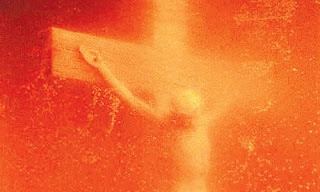
Piss Christ and the Incarnation

Image
Andres Serrano's photograph of the cross of Christ suspended in a beaker of the artist's own urine has, not surprisingly, evoked head-scratching perplexity and vigorous opposition and condemnation. An artist's commentary on his or her work is obviously a place start in assessing that work. Serrano comments: ""At the time I made Piss Christ, I wasn't trying to get anything across . . . In hindsight, I'd say Piss Christ is a reflection of my work, not only as an artist, but as  a Christian." Say what, Andres? Christian? Really? "The thing about the crucifix itself" he continues,"is that we treat it almost like a fashion accessory. When you see it, you're not horrified by it at all, but what it represents is the crucifixion of a man. And for Christ to have been crucified and laid on the cross for three days where he not only bled to death, he shat himself and he peed himself to death. "So if Piss Christ upsets you, m...

God’s BHAG and a Bigger and Better Gospel: Trinity and Incarnation

Jesus, God in human flesh, is the ultimate expression of God’s BHAG – his B ig H airy A udacious G oal. Such a goal is “ clear and compelling and serves as a unifying focal point of effort” that engages people in their “innards” and is “tangible, energizing, highly focused.  People ‘get it’ right away; it takes little or no explanation” (Collins, https://www.jimcollins.com/article_topics/articles/BHAG.html). The thing God wanted from forever, the divine BHAG, is for God and humanity to live together in friendship and love on this world he created for it. God desired this so much, to be so close to us, as close as he could possibly be, in fact, that he decided to become one of us!   His coming as one of us was always God’s plan. That was enormously complicated after humanity sinned and rejected friendship with him, to be sure. It now included the necessity to deal with sin and its effects in order to reclaim and restore humanity and creation to God’s intention for them. Do yo...
Image
When our oldest daughter, Sara, was a little girl of around six, she took ballet. I sometimes drove her to ballet lessons in our old Volkswagen Beetle. Once, as Sara pulled her seat belt and shoulder harness on, it made a slight hissing sound. This prompted her to observe with a giggle, “It sounded like the car passed gas.”* Being the kind of dad I am, I replied, “I thought it was you.” “Dad, I don’t do that anymore.” “Sara, honey, everyone passes gas.” “Yeah, I guess so. But God doesn’t.” “No. Probably not. But, I expect Jesus did when he lived on earth.” “Dad, they didn’t do that back then!” I assured her that they did and that such has always been part of being human and having bodies. . . Read more at https://anoddworkofgrace.blogspot.com/2017/12/does-god-pass-gas-christmas-meditation.html

God is already working. So what now? Las Vegas gives a clue.

Alan Hirsch May 23, 2017 One of the most basic assumptions of the incarnational missionary is to assume God is already involved in every person’s life and is calling them to himself through his Son. Our mindset should not be the prevalent one of taking God with us wherever we might go. It must be, instead, that we join God in his mission. This means that the missionary God has been active a long time in a person’s life. Our primary job is to try to see where and how God has been working and to partner with him in bringing people to redemption in Jesus. Understand- ing that all humans are made in the image and likeness of God (Gen. 1:27), and in the deepest possible way made for God, we can assume that every human is motivated by spirituality and search for meaning. Even idolatry indicates that people are seeking to worship something beyond themselves. It is deformed spirituality to be sure, but it is spirituality nonetheless—and you can work with that. Recognize that behind...

If You Think . . . (3)

Jesus Only Came to Earth Because We Sinned Why Did Jesus’ Come to Earth ? If you think Jesus only came to earth because we humans sinned and had to be rescued, you’ve got a surprise coming. That’s only a partial truth, and worse, when we make it the whole truth it ends up distorting the whole picture.           How’s that, you ask? Here’s a question for you: if Jesus came only because we sinned and needed to be rescued, doesn’t that make sin necessary? If God’s coming among us as one of us, the great miracle and mystery of the Incarnation, is only to rescue us from sin, then we had to sin for him to come, right? Otherwise, on this reckoning, Jesus would not have come, God would not be one of us, we would not truly know God, and all else the comes from the Incarnation that we find in scripture. I hope that strikes all of you as wrongheaded as it does me!           So it boils down to...

God is Displeased/Angry with Us (1st in a series "If You Think . . .)

“ God with a Scowl ”           “God” is the most dangerous word in any language. Dangerous because we invest it with so much of our search for significance and security. Dangerous because it can become whatever we rely on as our “ultimate concern” (Paul Tillich). Dangerous because we will do anything for whatever we deem “God.” And “believers” have and continue to do horrendous things in the name of their “God.”           Now all of us are “believers.” There’s something or someone that’s the bottom line for us and helps us make sense of our world and respond to the issues we face in life. I am only concerned here with the Christian deity, though. That that “God” has a major PR problem at present is no secret to anyone.           Part of this PR problem comes from the miserable track record of his people representing in the world, including ...

God, Violence, and War in the Old Testament

1.     God’s purpose and design for creation is divine-human communication/communion/community with humanity on this earth (pictured in Gen.3 by God walking with Adam and Eve in the Garden of Eden). In other words, God always intended to come among us and be with us as one of us. It was always his plan to send the incarnate Jesus Christ into the world to effect his purpose. 2.     God’s strategy was incarnational: to identify and enter into solidarity with his creatures in ever more intimate ways as his purpose unfolds through history. Development, change, and deepening were always to be features of this history. The principle: God meets the people where they (takes history seriously) and takes them on in the direction he wants them to go. 3.        After the Fall, this strategy is complexified. God now has to deal with the problem of sin and its distorting effects in his world to achieve his purpose. Violenc...

It’s Not About the Baby

Posted by debra dean murphy I’ve never liked the phrase “Jesus is the reason for the season.” It’s fine with me when people write “Xmas” instead of “Christmas.” I think the “war on Christmas” is falsely-hyped nonsense. It’s hard to square the militancy and sheer meanness  of those who insist on keeping Christ in Christmas with the Prince of Peace and the celebration of his birth.  Three thoughts: 1. It’s not about the baby. Read more at https://debradeanmurphy.wordpress.com/2011/12/12/its-not-about-the-baby/

Seven More Things You May Think Are True About Christianity But Are NOT.

  1.     The Bible’s God does NOT seek or enjoy punishing human beings (Lam.3:33)!   The “God with a Scowl” of such recent infamy is not the Christian deity. That “god” is creation of pagan thought, unworthy of either deity or humanity. The Christian God, on the other hand, is wholly love, implacably love. He will exercise “tough” love as discipline, as necessary but this love is always aimed at our restoration and growth.   2.     The Bible’s God is NOT uninterested or unaffected by our prayers.   Though it is popular to claim that prayer is good for the one who prays (and this certainly true), that God neither wants, or responds to our prayers is false. In fact, the chief good prayer does for the pray-er is to enter into a mystery – a relationship with a God who is not all uninterested in us and our perspective on things, our needs and wants. And one who does respond and under whose sovereign our lives and history itself u...

T. F. Torrance on the Jewishness of Jesus

Thus the knowledge of God, of Christ, and of the Jews are  all bound up inseparably together,  so that when at last God came into the world he came as a Jew. And to this very day Jesus remains a Jew while still the eternal Son of God. It is still through the story of Israel, through the Jewish soul shaped by the hand of God, through the Jewish scriptures of the Old Testament and the Jewish scriptures of the New Testament church, the gospel comes to us, and that Jesus Christ is set before us face to face as Lord and saviour. Apart from this Old Testament prehistory and all the biblical revelation through Israel, we would not have the tools to grasp the knowledge of God; apart from the long history of the Jews we would not be able to recognise Jesus as the Son of God; apart from the suffering and agony of Israel we would not understand the cross of Calvary as God's instrument to atone for sin and to enact once and for all his word of love and pardon and grace. Apart from the cov...

Slow Church: A Review

Image
     One of the great virtues of Slow Church (hereafter SC ), and there are many, is that one who knows only the traditional church will not easily recognize what they read there as having much to do with church! Before any meaningful steps toward fresh forms of church more resonate with the world we live in and the scriptures we live by can be taken, we must somehow come to term with the reality that church as we have known it no longer can or does “work” in our time and place.   This is a very difficult reality to accept “all the way down.”   No more tinkering, no more incremental recalibrating of the present system.   Instead, we need a fresh vision that can immerse us again in our scriptures and enliven our imaginations to dream new dreams about being God’s people in our own neighborhoods. That means “we can’t get there from here.”   It seems to me that the inherited structures, expectations, and history create an inertia that will not ...

Creation, ‘The World Was Made So That Christ Might Be Born’

http://growrag.wordpress.com/2014/01/04/creation-the-world-was-made-so-that-christ-might-be-born-2/   January 4, 2014 by Bobby Grow by Bobby Grow In some of my posts, especially of late, we have been thinking about the Christian doctrine of Creation; as corollary, we have also been considering our relation to creation in and through Christ. The first step we ought to engage, in our consideration of such things, is to wonder about the God-world relation and what purpose he has always already intended for creation as the counterpoint to his gracious life of love, from which he created. It becomes quickly obvious, as we read the New Testament, and work out the theo-logical implications of Trintarian and Christo-logical assumptions, therein; that creation was created with Christ in mind, and us in Christ. So that God’s original intent, was in and through Christ, to bring all of creation (and humanity as the pinnacle of his creation) into his life of perichoretic (inte...

Denying Christ’s Body: The Dangers of Ecclesial Gnosticism

Image
May 23, 2014  By  Ragan Sutterfield   0 Comments The oldest heresies in Christianity have been those that have denied the body—Christ’s body, our bodies.  Gnosticism is a name that applies to a good many of them, Docetism another.  The idea is that God is too great to have taken on a  human body  and that the material realities of our body are too lowly to be welcomed into the eternal kingdom of God.  The Docetists said that Christ appeared to be human but that he didn’t have real flesh and bones—he was human image without human substance.  The Gnostics believed that the body was the source of evil, a trap that we would move beyond in order to move into the highest emanations of a pure and disembodied Wisdom. These heresies were and are popular and attractive because resonate—we often experience our bodies as a trap.  Who hasn’t wished that they could be free of their body at some point?  We have all had illnesses that have ...