Posts

Showing posts with the label cross

Theological Journey - April 10: Toward the 8th Day (Good Friday

Image
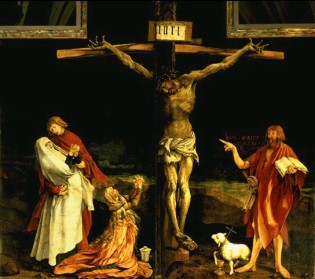
  Theological Journal – April 10   "Standing near the cross of Jesus was his mother..." Martin Luther writes of this remarkable scene: "What agony Mary endured as she watched his suffering none can comprehend. In all history there is no other account of a woman who followed her son when he must suffer so frightfully. She saw him crowned with thorns, spat upon, and hanged. Truly the sword of  Simeon must have gone through her heart. A mother can scarcely stand it if her child falls from a bench or bleeds from the ear. Where shall we find a mother who could see such things as Mary? She could not speak but must watch all the tortures and hear all the revilings as they gave him vinegar to drink and diced for his clothing. To be sure, the Holy Spirit gave her comfort, but other mothers would have fainted. And for Christ, to see his mother suffer was one of the greatest parts of his pain, that nothing should be lacking in his suffering."

Theological Journal - March 30: The Crucified God

“The crisis of the church in present-day society is not merely the critical choice between assimilation or retreat into the ghetto, but the crisis of its own existence as the church of the crucified Christ . . . for only by Christ is it possible to tell what is a Christian church and what is not. Whether or not Christianity, in an alienated, divided and oppressive society, itself becomes alienated, divided and an accomplice of oppression, is ultimately decided only by whether the crucified Christ is a stranger to it or the Lord who determines the form of its existence . . . As far as I am concerned, the Christian church and Christian theology become relevant to the problems of the modern world only when they reveal the 'hard core' of their identity in the crucified Christ and through it are called into question, together with the society in which they live . . . Faith, the church and theology must demonstrate what they really believe and hope about the man from Nazareth who...
Theological Journal – March 2 (Lent2020) Moltmann Monday I’ll be quoting from The Crucified God during Lent. “Jesus did not suffer passively from the world in which he lived, but incited it against himself by his message and the life he lived. Nor did his crucifixion in Jerusalem come upon him as the act of an evil destiny, so that one could speak of a heroic failure, as heroes have often failed and yet remained heroes to posterity. According to the gospels, Jesus himself set out for Jerusalem and actively took the expected suffering upon himself. By proclaiming the righteousness of God as the right of those who were rejected and without grace to receive grace, he provoked the hostility of the guardians of the law. By becoming a ‘friend of sinners and tax-collectors’, he made their enemies his enemies. By claiming that God himself was on the side of the godless, he incited the devout against him and was cast into the godlessness of Golgotha. “The more the mysticism o...

Theological Journal – February 12, 2020 What Dietrich Bonhoeffer Would Say to the North American Church (5)

5.        Fifthly , DB would point us to the “theology of the cross” and say “You Gotta Look Good on Wood.” Two contrasts clarify what he means here. DB followed the reformer Martin Luther is stressing the “theology of the cross” over against the “theology of glory.” The difference is nicely captured here: “A theology of glory … operates on the assumption that what we need is optimistic encouragement, some flattery, some positive thinking, some support to build our self-esteem. Theologically speaking it operates on the assumption that we are not seriously addicted to sin, and that our improvement is both necessary and possible. We need a little boost in our desire to do good works…. But the hallmark of a theology of glory is that it will always consider grace as something of a supplement to whatever is left of human will and power. “A theology of the cross defines life in terms of giving rather than taking, self-sacrifice rather than self-pro...

Theological Journal – February 10 Moltmann Monday

"The cross is not something historically fortuitous which might not have happened. God himself is nothing other than love. Consequently Golgotha is the inescapable revelation of his nature in a world of evil and suffering." ( The Trinity and the Kingdom ) Do you ever wonder what life will be like then and there and how different it will be from the here and now? I do. And what I’ve come to realize Moltmann captures in this quote. It’s this: “in a world of evil and suffering.” What will be different then and there is not how we will act and behave or what we will be expected to do. Everything required of us here and now will be required then and there. -loving still means serving others -their interests remain more important than our own -“dominion” over the creation (Gen.1:26-28) remains “tilling and keeping“ (or “protecting and serving”) it (Gen.2:15) -“glory” means “fastening our belts, bidding those other and less than us to sit down to eat,...

Easter 2018

Sleep eludes me this night forcing me to keep an Easter Vigil I did not choose. I find myself musing on St. Mark’s passion and resurrection story, odd as it is (though terribly characteristic of this gospel writer). One of its oddities is that it is pagan Roman centurion who announces Jesus’ death boldly declaring the last thing I’m sure he ever expected to be saying at that moment, “Truly, this man was God’s Son!” (Mk.15:39). The emperor was believed to be son of deity; yet here it is one pinned to a cross in a humiliating death that is so acclaimed. What did that centurion see in the dying/dead Jesus that evoked such a profession? We’ll never know, of course. And perhaps that’s the point. Against all expectation and probability this death, in all it gruesome horror, spoke to the centurion the last thing he expected to hear: a word of divine love and even victory. I can’t get the words of Paul in 2 Cor.4 out of my mind (especially vv.10-12):  “ But we have this treasure...

43. Mark 10:32-45: Three Passion Predictions

After this section on “Stuff” Jesus issues the third prediction of his suffering, death, and resurrection to the disciples. We’ll look at the three as a group here and trace out their commonalities and developments (keep your Bible open to refer to each of the passion predictions in chs.8,9,10). A first commonality is that all occur on the way to Jerusalem. But they occur at different stages on the journey. The first happens at Caesarea Philippi, the second passing “through Galilee,” and the third drawing near to Jerusalem. All along the way on this journey Jesus presses this truth upon them. It is clearly the heart of his message. In the first and third predictions Mark says Jesus “began” to teach his disciples. Apparently, they are always “beginning” to try and grasp what he is telling them. And they always fail. Though he taught “quite openly” the disciples think they understand, do not understand, and are afraid. Mark demonstrates this by posturing the disciples as being al...

Reading World History from the Theology of the Cross

Onward and upward is the hope of any and every people group no matter how large or small. Human betterment is an obvious and understandable goal for all to aspire to. The church too sends out missionaries and other workers to aid in such betterment. Sometimes we’re even tempted to believe it might just happen! And in certain ways and places it has. Yet even as the church engages in such work for human betterment, we (should) live by a theology of ministry that follows Jesus’ own pattern of engagement – a cruciform, or cross-centered, pattern. His resurrection validated and vindicated this cruciform pattern of life for Jesus’ followers between his ascension and return. And that’s where the rub comes for many of us. We seem to think that Jesus’ victory through his resurrection means that his followers in history will (or should) be victorious too. That is, we believe the church should be -a cultural power, -a moral exemplar and judge, and -a major contributor to human ...

A Whitewater Faith for the 21st Century

Our culture is often likened to whitewater rapids - ever-changing, unpredictable, dangerous. There are some rules for rafting these whitewater rapids, though, that might give us some guidelines for navigating these cultural rapids. I've translated them into biblical guidelines for a "whitewater faith" for navigating such times. 1. Rest during the calms because there is more turbulence coming/"Remember the Sabbath day and keep it holy" 2. When a rock looms ahead, lean into it not away from it/"Take up your cross and follow me" 3. Whatever else you do, never stop paddling/"Rejoice always, pray without ceasing, give thanks in all circumstances, for this is the will of God in Christ Jesus for you" 4. Let everything else but your life jacket go if you fall into the water/"There is salvation in no one else, for there is no other name under heaven given among mortals by which we must be saved" (in the sense that whoever find...

Wednesday of Holy Week

Image
Entry into the City, John August Swanson, 1990. Wednesday of Holy Week 2017             The central figure of Swanson’s painting is, of course Jesus riding into town on a donkey.  But . . . “Have you heard the legend of the Christian donkeys? This is the story that has been told about the little donkey who was Jesus’ mount on Palm Sunday. “It is said that a donkey carried Mary to Bethlehem and is also referred to as a Nativity Donkey.   The Nubian burro has a cross on its back because it is believed that these donkeys carried Jesus to Jerusalem on Palm Sunday. “To ride on a donkey signified coming in peace, this symbolic event served to reinforce what Jesus had told the people of Israel: “Rejoice greatly, O daughter of Zion; shout, O daughter of Jerusalem: behold, thy King cometh unto thee: he [is] just, and having salvation; lowly, and riding upon a donkey, and upon a colt the foal of a d...

Lent: Call to an Altared/Altered Life

Romans 12:1-2 12  1-2  So here’s what I want you to do, God helping you: Take your everyday, ordinary life—your sleeping, eating, going-to-work, and walking-around life—and place it before God as an offering. Embracing what God does for you is the best thing you can do for him. Don’t become so well-adjusted to your culture that you fit into it without even thinking. Instead, fix your attention on God. You’ll be changed from the inside out. Readily recognize what he wants from you, and quickly respond to it. Unlike the culture around you, always dragging you down to its level of immaturity, God brings the best out of you, develops well-formed maturity in you.   (The Message) Sixth Sunday in Lent Unlike the culture around you, always dragging you down to its level of immaturity, God brings the best out of you, develops well-formed maturity in you. What is this “culture” Paul warns about here? Misunderstanding and mischief follow not getting this right. “Cult...

Our task as the church

  Our task as the church is not to “change the world,” “make the world a better place to live,” or be the “moral guardians” of our time and place. -The first is Christ’s job, and he’s done it. -The second is a pagan preoccupation. -The last is a perversion of the gospel. Christ has changed the world. Period. That’s what the cross and resurrection are all about. Sin has been forgiven. The powers are defeated. New creation has dawned. The old world is passing away. The church lives from and into this new world amid the old world that is passing away. The church is not about “making the world a better place to live.”   That’s what the old world, the pagan world is up to. It’s about “Making America Great Again.” The church, however, is about demonstrating a new world, a new way of being human that in Christ has become our destiny. The church lives a conflicted relationship with the old world, the old way of being (sub)human. Indeed, it’s presence is a reminder t...

Fourth Sunday of Advent (12.18.16)

Image
Matthew 1:18-25 18  Now the birth of Jesus the Messiah [ a ] took place in this way. When his mother Mary had been engaged to Joseph, but before they lived together, she was found to be with child from the Holy Spirit. 19  Her husband Joseph, being a righteous man and unwilling to expose her to public disgrace, planned to dismiss her quietly. 20  But just when he had resolved to do this, an angel of the Lord appeared to him in a dream and said, “Joseph, son of David, do not be afraid to take Mary as your wife, for the child conceived in her is from the Holy Spirit. 21  She will bear a son, and you are to name him Jesus, for he will save his people from their sins.” 22  All this took place to fulfill what had been spoken by the Lord through the prophet: 23  “Look, the virgin shall conceive and bear a son,     and they shall name him Emmanuel,” which means, “God is with us.” 24  When Joseph awoke from sleep, he did as the...

Some Theses on the Church in North America Today (9)

9.     Two matters continue to divide the church which in my opinion should not. One is “the devil” and the other is the “virginal conception” of Jesus. Not the “virgin birth” as it is usually styled. Jesus’ birth was the same as any other baby ever born. The Bible is clear that it is his conception that distinguishes him for all other babies. But let’s look at the devil first. C. S. Lewis famously said that making too much or too little of the devil are equal and opposite errors we should avoid. What the Bible says, which is what we need to stick to in heeding Lewis’ counsel, is basically that God has some intentional, intelligent, and crafty opposition in the cosmos from a supra-human cohort of rebellious creatures who resist serving him. At the head of this cohort is a figure called (the) Satan or the devil, apparently the chief and leader of these rebels. This figure develops from Old Testament to New from a member of God’s heavenly council who task is to te...

N. T. Wright’s The Day the Revolution Began: Reconsidering the Meaning of Jesus’s Crucifixion (3)

Image
Ch.3: The Cross In Its First Century Setting           The original ancient setting for considering the cross is the Greco-Roman world of late antiquity. The ethos of that world as defined by its great poets and story-tellers was wrath (Homer, The Illiad ) and arms (Virgil, the Aeneid ). Gods or humans, everyone and everything was implicated in these two realities.           This is why that world executed certain people in the brutal and degrading way of crucifixion. IT was designed not simply to kill the criminal but to do so in a degrading fashion. As an example to break the spirit of any onlookers who might be contemplating actions of a treasonous or seditious nature. This assertion of sheer power carried the message of the futility of such actions. That crucifixion often left the condemned person hanging alive in torturous suffering begging for release brought the trifecta of degrada...