Posts

Showing posts with the label Easter

Theological Journal – April 18: Bonhoeffert on Easter and Resurection

From Letters and Papers from Prison (Kindle edition) “The Christian is not a homo religiosus but simply a human being, in the same way that Jesus was a human being—in contrast, perhaps, to John the Baptist. I do not mean the shallow and banal this-worldliness of the enlightened, the bustling, the comfortable, or the lascivious, but the profound this-worldliness that shows discipline and includes the ever-present knowledge of death and resurrection.” 6211-6219 Bonhoeffer is famous (or infamous) for his calls for a secular or non-religious Christianity. He makes it clear in this passage that he is not recommending that the church simply join in and go with the flow of wherever the prevailing cultural winds take us (though he has been [mis]interpreted to mean that). He characterizes that way of living as: -“enlightened” -“bustling” -“comfortable” -“lascivious” Or what we might call a middle-class or above way of life give to business, busy-ness, consumerism, and pleasure....
Theological Journal – April 16: Bonhoeffer on Easter and Resurrection

From Letters and Papers from Prison (Kindle edition) “What is so liberating about Good Friday and Easter is the fact that our thoughts are pulled far beyond our personal circumstances to the ultimate meaning of all life, suffering, and indeed everything that happens, and this gives us great hope.” (Kindle location 511) While it is possible to individualize Good Friday (“Were you there when they crucified my Lord”) and Easter, and has often been done in Western Christianity, Bonhoeffer sees biblically what is truly at stake at the cross and in the resurrection. Unless we see the cosmic scope of what happened there we miss the full significance and glory of Easter weekend. It all gets reduced down to my sins and my forgiveness, which is good news nut not Good News. Unless we see the whole cosmos gone wrong loaded on Jesus’ shoulders on the cross and raised with him as new creation we miss what Bonhoeffer here calls the “great hope” which is rightfully ours.  

Theological Journal - April 15: Bonhoeffer on Easter and Resurrection

From Letters and Papers from Prison (Kindle edition) “Being able to face dying doesn’t yet mean we can face death. It’s possible for a human being to manage dying, but overcoming death means resurrection. It is not through the ars moriendi but through Christ’s resurrection that a new and cleansing wind can blow through our present world . . . If a few people really believed this and were guided by it in their earthly actions, a great deal would change. To live in the light of the resurrection—that is what Easter means.” (Kindle loc.4352) The rest of the week will be devoted to explore some of Bonhoeffer’s observations about Easter and resurrection in his Letters and Papers from Prison . Coming to terms with dying is a noble human venture, no doubt. It certainly beats the denial of death so rampant in our culture. Yet that is merely a capitulation to the powers of the old age that hold the world in their deathly grip. As Bonhoeffer notes it is “overcoming death” that brings...

Theological Journal - April 13: Easter

Theological Journal – April 13 Moltmann Monday – Easter “Believing in the resurrection does not just mean assenting to a dogma and noting a historical fact. It means participating in this creative act of God’s … Resurrection is not a consoling opium, soothing us with the promise of a better world in the hereafter. It is the energy for a rebirth of this life. The hope doesn’t point to another world. It is focused on the redemption of this one.” ― Jürgen Moltmann, Jesus Christ for Today's World (Kindle loc.83 Jesus’ resurrection is a reality as or more relevant to the here and now than the then and there! That’s what Moltmann claims here. Contra Karl Marx, Christianity, based on the assurance of a hope for life with God after death in the then and there, is for Moltmann, based on that same resurrection, an energetic “steroid” for life with Jesus before death in the here and now. He is about a “Christianity Today,” not a “Christianity Tomorrow”! As Moltmann says, “The ...

Theological Journal - April 14: Torrance Tuesday: Easter

“The resurrection . . . means that God has established a real bond between his reality and ours in this world. In Jesus Christ he has made his divine reality to intersect and overlap with ours, so that we in Jesus Christ may actually and truly know God and have communion with him without having to take leave of the realm of our own this-worldly existence” ( Atonement: The Person and Work of Christ , 233). Human sin, our heinous refusal to live in relationship to God but rather to live by ourselves, for ourselves, and by our own power, sundered the reality of God from the existence we tried to carve out for ourselves to live and rule in. Heaven and earth, the realm of God and the realm of humanity were meant to overlap and interlock with each other in an organic unity, open to and receptive of each other with free and open concourse between the two. Sin separated these realms and hardened by difference between them into impermeable boundaries. Or so we thought . . . hoped. G...

Theological Journal - April m12: Toward the 8th Day (Easter Sunday)

  A most peculiar Easter Sunday this year. A raging worldwide pandemic, massive unemployment and financial dislocation, death, death, and more death. Severe and even tornadic weather threatens us here in East Texas. I had originally included John Updike’s famous Easter poem “Seven Stanzas of Easter” here for today’s post. But I feel compelled to go a different direction with this Easter post this year. I have three things bouncing around incessantly and insistently in my mind and heart this morning. Three related yet distinct notes keep sounding over and over again as I sit before the he engulfing tragedy that has beset our nation and world, the regional storms in our area, and the inner turmoil I feel as I try to process all this chaos. -“fearful, tearful, yet cheerful”: I cannot and do not want to avoid the terror and destruction tearing us apart. Yet I cannot deny the hope that comes with Easter that Christ is risen, death is defeated, and all deathly things that threate...
Image
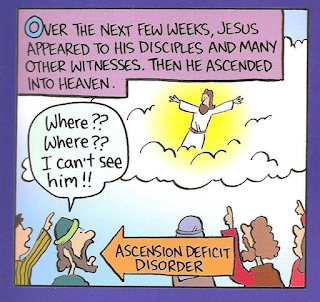
Ascension: The God Who Completes (Credit to Inherit the Mirth ) Sadly underemphasized but monumentally important Jesus’ ascension saves our faith from becoming “merely” Easter-centered (as if Jesus work for us is over) or “merely” Pentecost-centered (as if the Spirit’s work is somehow other or different from Jesus’). The ascension completes Jesus’ -journey from heaven to earth and back to heaven -work of salvation from womb to tomb to heavenly throne room -achievement of God’s eternal purpose Thus, the God we meet in the face and work of Jesus is the God who completes all he has desired and worked for. No stronger affirmation of divine faithfulness is available or needed. Mention of heaven and Jesus flying through the sky on way there account for much of the embarrassment and perplexity many feel about this part of Jesus’ story. Though the USSR cosmonaut Yuri Gagarin is famously reported to have said that on his trip into space in 1961 that he looked around and did...

Easter 2018

Sleep eludes me this night forcing me to keep an Easter Vigil I did not choose. I find myself musing on St. Mark’s passion and resurrection story, odd as it is (though terribly characteristic of this gospel writer). One of its oddities is that it is pagan Roman centurion who announces Jesus’ death boldly declaring the last thing I’m sure he ever expected to be saying at that moment, “Truly, this man was God’s Son!” (Mk.15:39). The emperor was believed to be son of deity; yet here it is one pinned to a cross in a humiliating death that is so acclaimed. What did that centurion see in the dying/dead Jesus that evoked such a profession? We’ll never know, of course. And perhaps that’s the point. Against all expectation and probability this death, in all it gruesome horror, spoke to the centurion the last thing he expected to hear: a word of divine love and even victory. I can’t get the words of Paul in 2 Cor.4 out of my mind (especially vv.10-12):  “ But we have this treasure...

Slouching Toward Easter

Image
          Why is there so little passion/enthusiasm in the church today? This was a question asked on FB today. I responded, “Our God is too distant, our Christ is too small, and the Holy Spirit is elsewhere. Our churches do not know who or what they are or what they are to do in the world. Otherwise everything is just peachy.” I was not being flip. That is what I really believe.           Shortly after another post came up on my feed from Mike Frost about the greatest Easter painting ever. He proposes The Disciples Peter and John Running to the Sepulchre on the Morning of the Resurrection or simply The Disciples (1898). Its artist is little known Swiss, Eug ѐ ne Burnand and the painting is hung in an old railway station in Paris on the left bank of the Seine.                    John and Peter are rushing to the tomb having ju...
Image
Is this the greatest Easter painting of all time? by  Mike Frost  | Apr 12, 2017 |  Homepage  |  1 comment It has the imposing title,  The Disciples Peter and John Running to the Sepulchre on the Morning of the Resurrection. More often than not it’s just referred to by the shortened form,  The Disciples  or  Les Disciples. You won’t find it in the Louvre or the Met or the National Gallery. It hangs tucked away in an old railway station in Paris, now the Musée d’Orsay, on the left bank of the Seine. It was painted in 1898 by a relatively little known Swiss artist named Eugène Burnand. He was something of an old-fashioned realist at a time when all the cool kids were embracing modernism.  The Disciples  didn’t make a splash when it was first hung. Burnand’s style was already considered passé by the 1890s. But those who take the time to find it in the d’Orsay come away saying that viewing the canvas is akin t...

The resurrection isn’t an argument. It’s the Christian word for defiance

Giles Fraser On Friday, all was lost. Richard Dawkins and his smirking acolytes had got it right, blast them. I know the atheist recital better than most. Religion is a busted flush. The dream turned out to have been a fantasy. Perhaps we all got carried away by the charisma. But now, it seems, the one we had followed had over-promised. So it’s time to pack up our chalices and do something useful. Time to admit the truth: it had all been a lie and a waste. But that was Friday . On Sunday morning, just before dawn, a group of us gathered outside church and kindled a small bonfire. From there we passed the flame to a large candle and processed it into the nave – the tentative, flickering light illuminating the dark corners of the building. And from that large candle, we all lit our own individual candles, passing the light from one to another. Everything now starts again. Hallelujah, Christ is risen. Without this, the whole Christian faith is nonsense. Read more at http:...

Easter! Now What?

          Lent is over. Easter is here. Hot Cross buns have been eaten. Pageants performed. The great Easter hymns sung. But what’s next? Where do we go from here?           Life seems to return to “normal.” But the Easter message is that the Risen Christ has made all things new. What is this newness and how do we identify and participate in it?           Fortunately, C. S. Lewis has given us a wonderful fictional depiction of our participation in Christ’s resurrection triumph. In Prince Caspian , the second in the original published order of the Narnia Chronicles, the four Pevensie children from our world have returned to Aslan’s world of Narnia. There are a great kings and queens. They have been called to aid Prince Caspian, a young royal whose scurrilous uncle had his father killed and claimed the throne of Narnia for himself. Having no male hei...

“Christ is Risen. He is Risen Indeed!”

Jesus stands before you. Yes, that Jesus. The one the Romans crucified on Friday afternoon. Yet he stands before alive again on Sunday morning.           He’s the same Jesus. The real Jesus. He eats food the way he always did. The gash in his side and the holes in his hands and feet are beyond doubt.           Yet he’s different, too. He seems able to appear where he wishes. He can pass through locked doors.           He’s the same Jesus. The one we betrayed, before whom we are guilty. We thought he failed, disappointed us. Don’t know what to think now. Same with our despair, hopelessness, and fear. What must he think of us now!           Yet he’s different, too. Jesus is here with no recrimination or blame for us. No suspicion or disappointment or victimization. Only happiness to see us again...

Jesus the great debt-eliminator

Image
                             Ross Gittins                                     In both capitalism and Christianity, the more you've sinned, the bigger the dollop of forgiveness. Photo: Ron Tandberg At this time of our greatest Christian holy-days, what does the Bible have to say about economics? A lot more than you may think. That's according to the Czech economist Tomas Sedlacek, whose book, Economics of Good and Evil , I'll be heavily relying on in this column. When God expelled Adam and Eve from the Garden of Eden after they had disobeyed him, part of their pu...

1.Easter with Flannery O’Connor

Image
http://www.firstthings.com/web-exclusives/2014/04/easter-with-flannery-oconnor by George Weigel 4 . 16 . 14 T his coming August 3 will mark the golden anniversary of Flannery O’Connor’s “Passover,” to adopt the biblical image John Paul II used to describe the Christian journey through death to eternal life. In the fifty years since lupus erythematosus claimed her at age thirty-nine, O’Connor’s literary genius has been widely celebrated. Then, with the 1979 publication of  The Habit of Being , her collected letters, another facet of O’Connor’s genius came into focus: Mary Flannery O’Connor was an exceptionally gifted apologist, an explicator of Catholic faith who combined remarkable insight into the mysteries of the Creed with deep and unsentimental piety, unblinking realism about the Church in its human aspect, puckish humor—and a mordant appreciation of the soul-withering acids of modern secularism. Read more at http://www.firstthings.com/web-exclusives/2014/...

Is Easter ‘Happy’?

Image
     Posted by Abdul Alim For the Muslim Times’ extensive collection on Easter, please click here By  Rev. Dr. Susan Brooks ;  Professor of Theology, Chicago Theological Seminary Huff Post: ‘Happy Easter!’ You hear it everywhere, in malls, in streets, and in churches. But is the Christian celebration of Easter really a happy occasion? Easter is profoundly misunderstood as “Happy” unless we understand the entire drama of resistance to suffering and death, and the shocking cost of that resistance, that Easter entails. Encountering the depths of the worst human life holds can then lead to the astonishment of Easter, the ‘nevertheless’ of triumph, the central liturgical moment of the Christian year. Easter is “Happy” in the same way that Pharrell’s “Happy,” a song written for an animated film, has become a way to  express resistance  by people living under repressive regimes, or under threat, as in  this version from Kiev . One ...

SEVEN STANZAS AT EASTER

http://lawsonstone.seedbed.com/2015/04/03/john-updike-unlikely-celebrant-of-easter/ John Updike Make no mistake: if He rose at all it was as His body; if the cells’ dissolution did not reverse, the molecules reknit, the amino acids rekindle, the Church will fall. It was not as the flowers, each soft Spring recurrent; it was not as His Spirit in the mouths and fuddled eyes of the eleven apostles; it was as His flesh: ours. The same hinged thumbs and toes, the same valved heart that–pierced–died, withered, paused, and then regathered out of enduring Might new strength to enclose. Let us not mock God with metaphor, analogy, sidestepping, transcendence making of the event a parable, a sign painted in the faded credulity of earlier ages: let us walk through the door. The stone is rolled back, not papier-mâché not a stone in a story, but the vast rock of materiality that in the slow grinding of time will eclipse for each of us the wide light of day. And if we...