Posts

Showing posts with the label Isenheim Altarpiece

Second Sunday of Advent (12.4.16)
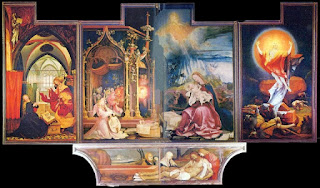
Image
3   In those days John the Baptist appeared in the wilderness of Judea, proclaiming, 2  “Repent, for the kingdom of heaven has come near.” 3  This is the one of whom the prophet Isaiah spoke when he said, “The voice of one crying out in the wilderness: ‘Prepare the way of the Lord,      make his paths straight.’” 4  Now John wore clothing of camel’s hair with a leather belt around his waist, and his food was locusts and wild honey. 5  Then the people of Jerusalem and all Judea were going out to him, and all the region along the Jordan, 6  and they were baptized by him in the river Jordan, confessing their sins. 7  But when he saw many Pharisees and Sadducees coming for baptism, he said to them, “You brood of vipers! Who warned you to flee from the wrath to come? 8  Bear fruit worthy of repentance. 9  Do not presume to say to yourselves, ‘We have Abraham as our ancestor’; for I tell you, God is able from thes...

First Sunday of Advent 2016

Image
                                                  36  “But about that day and hour no one knows, neither the angels of heaven, nor the Son, but only the Father. 37  For as the days of Noah were, so will be the coming of the Son of Man. 38  For as in those days before the flood they were eating and drinking, marrying and giving in marriage, until the day Noah entered the ark, 39  and they knew nothing until the flood came and swept them all away, so too will be the coming of the Son of Man. 40  Then two will be in the field; one will be taken and one will be left. 41  Two women will be grinding meal together; one will be taken and one will be left. 42  Keep awake therefore, for you do not know on...

The Iconography of Sorrow: How Easter Transforms Our Response to Suffering

Image
  Luke Bretherton ABC Religion and Ethics 31 Mar 2015 It should not be the fickle attention of Western media that determines who appears as the subject of care. Uncoupled from contemplation of Christ crucified, we misperceive what suffering looks like. Credit: vincent desjardins / Wikimedia Commons From pictures of poor farmers in Depression era America to bloated children in Sudan, the contemporary aesthetics of poverty subtly reinscribe the ancient division between the children of the soil ( chthonoi ) and children of the gods ( theion ) familiar to us from the Greek and Babylonian myths. Those who live some form of what is often deemed the ideal "Western" lifestyle look down from Olympus with sympathy on the sons and daughters of the soil and their visceral imprisonment to nature and necessity. "We" who benefit from consumer lifestyles, technological advancement and decent sewers contemplate the photographs of stricken faces an...