Posts

Showing posts with the label Barth

Theological Journal – August 8 Law and Gospel

The Law neither precedes the Gospel as an independent word from God (natural theology), not a separate word from God as a challenge to or competitor with it. Neither is the Law dispensable to the Gospel after Christ (as superseded, fulfilled, or done away with). But what is the relation of the Law to the Gospel? As usual, Karl Barth helps us understand. We must reject, claims Barth, any version of the Law that requires us to do ‘something’ to make the gospel apply to us.” We must affirm that the Law expects us to do something since on account of Christ the Gospel already applies to us. Thus “works righteousness,” earning our way with God, is not a concern for Barth as it is with Luther. Luther’s believes we are utterly passive and do nothing with regard to God; God does everything. Barth cannot buy into this. The problem with works righteousness is not that we do something, take some action with regard to God, thus making human passivity the model of faithfulness (as has often be...

Theological Journal – February 19 What’s Joy Got to Do With It? (1)

One can parse the ills of the church in the West in many different ways and from many different perspectives. In this series I want to come at it from the angle of joy. I take my bearings from Karl Barth who comes nigh unto making joy the chief attribute of God: “It is (God’s) glory that awakens joy, and is itself joyful. It is not merely a glory which is solemn and good and true, and which, in its perfection and sublimity, might be gloomy or at least joyless… It is something in God, the God of all the perfections, which justifies us in having joy, desire and pleasure towards Him, which indeed obliges, summons and attracts us to do this.” (CD II.1, 655). “Obliges, summons, and attracts” – duty, response, and delight. The joy that God is and exudes is, shapes, and spices the life we live as his creatures. The question this raises for me is how such joy impacts life which, as Thomas Hobbes famously describes it, is “nasty, brutish, and short” in the state of nat...

Theological Journal – January 28 Torrance Tuesday – Four Traits that Made Barth a Great Theologian according to T. F. Torrance

Thomas Torrance was close to Karl Barth, studied with Barth, was a primary editor of Barth’s Church Dogmatics, and was asked by Barth to continue writing the unfinished Church Dogmatics (CD) after him. He has influenced many Anglo-American students to give Barth a fairer hearing than he was wont to receive in the Anglo-American world during much of the 20 th century. His book Karl Barth: An Introduction to His Early Theology 1910-1931 lists four traits that he believed made Barth a great theologian. #1 An Inquisitive Mind “Barth has the most searching, questioning mind I have ever known,” notes Torrance. He estimates that all the questions Barth raises would fill “hundreds of hundreds of pages.” Barth discovered that the liberal theology he had been taught had been exploded by him seeing many of his esteemed professors sign on in support of the Kaiser’s war policy in 1914. In reworking theology from the ground up he had to ask lots of questions! With them Barth sough...
Image
Ponderings for Christmas We start with the ridiculous and move toward the sublime. Or maybe it’s the other way round. Or ,maybe, even, the sublime is found in the ridiculous. Decide for yourself. Christmas with Calvin and Hobbes Does God “ever show himself and prove his existence”? Nor do I! Seems to work for Christians in the US, huh? Martin Luther and the Christmas Tree According to tradition, Luther may have also popularized the tradition of the Christmas tree as a way to express and teach theology to his family. The story goes that, while he was on his way home one evening, he became overwhelmed by the incredible beauty of a fir tree positioned against the backdrop of the brilliant starlit sky. He so desperately wanted to describe what he had seen to his family, but the words failed him. So he ventured back outside and chopped down one of these trees, bringing it home to share with his family. He even decorated the tree with candle ...

Advent Gives Us the Finger

Image
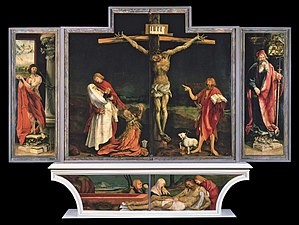
Matthew 3:1-12 Karl Barth kept a picture of the Isenheim Altarpiece over his desk most of his life. What most captured Barth’s attention was the long, bony finger of John the Baptist pointing to the crucified Jesus Christ hanging agonizingly on the cross. That long, bony finger of the Baptist’s witness to Christ became the central theme for Barth of Christian vocation – witness. I call it Advent giving us the finger! Yes, Advent gives us the finger – the finger of witness. It witnesses to us of Jesus Messiah and his coming to gather and reconstitute Abrahamic Israel from ethnic Israel and calls us to witness to our world of the work of Jesus Messiah through this reconstituted Jewish and then Gentile Abrahamic people. Advent equips us to give the finger (of witness) to the world. We witness -to the darkness of the world in which each Advent dawns, -to the darkness in each of us in whom Advent dawns, -to the new life for Abrahamic Israel – and through ...

Bird Cages or Bird Baths – Some Late Night Musings

Some years ago the idea that the church should be a centered set rather than a bounded set. The latter is like a bird cage enclosed by metal bars and entered only through a small opening. The point is to get inside the metal enclosure and every effort is expended to police that entrance to keep the unqualified out. The former is like a bird bath. It has open boundaries at its edges. Those who enter move to the center where the deepest, coolest waters are to refresh and clean themselves. Helping those at the boundaries move to the center is the action desired here. Closed or barely permeable boundaries and clear differentiation between who is in and who is out or open boundaries with movement to the center by those who may or may not have clear commitments at the point of entering the bird bath. The church in America has been largely a bird cage church. Getting people in and making sure their commitment is sound has been the norm. However, the day for this kind of church here is ...

Psalm 2 (Post 5)

Psalm 2 Structure and Classification -royal psalm: perhaps used at enthronement celebrations of new kings -the “happy” or “blessed” of v.12 ties back to the “happy” or “blessed” of 1:1 tying the two psalms together as introductory to the whole psalter. The themes of Torah and Throne/Temple cover the chief emphases of the psalms. “One Jewish tradition treated Pss.1 and 2 as one psalm, and this reflects a number of points of connection between the two. Psalm 2 opens with an ironic link.  Whereas people of insight talk about Yhwh’s teaching (1:2), nations and peoples also talk something -emptiness (2:1). It closes with another link. Whereas Ps.1 ends with the prospect of the path of the wicked perishing, 2:12 envisages nations perishing as regards the path. Whereas the opening of Ps.1 comments on the good fortune of people who walk in the right way, Ps.2 closes with a comment on the good fortune of everyone who relies on Yhwh. That declaration thus forms a bracket round the...

What I Believe I/We must Learn from Theology

From Karl Barth we need to learn anew that it is God speaking to us in Holy Scripture’s witness to Jesus Christ in the power of the Spirit. From Dietrich Bonhoeffer we must learn that Christendom is over, to perpetuate it is folly, that is, unfaithfulness based on fear and lack of discernment), church must be rediscovered in the local, in the last and the least, and in the double immersion in the daily life of the world and the   life of Jesus to discern the will and way of God among us re recommends in his Letters and Papers from Prison. From Michel de Certeau that the task of the church is to establish boundaries and create a space, a home for its members and at the same time transgress those boundaries in openness and welcome to those outside. From Rene Girard that desire, disorded desire, mimicking what God and others do, have, and are generate the violence that corrodes and degrades all of us and our world. From the Liberation theologians that God exercises ...

A Lot of this going around these days

Our relation to God is ungodly. We suppose that we know what we are saying when we say “God.” We assign to him the highest place in our world: and in so doing we place him fundamentally on one line with ourselves and with things. . . . We press ourselves into proximity with him: and so, all unthinking, we make him nigh unto ourselves. We allow ourselves an ordinary communication with him, we permit ourselves to reckon with him as though this were not extraordinary behavior on our part. We dare to deck ourselves out as his companions, patrons, advisers, and commissioners. ... Secretly we are the masters in this relationship. We are not concerned with God, but with our own requirements, to which God must adjust himself. . . . Our well-regulated, pleasurable life longs for some hours of devotion, some prolongation into infinity. And so, when we set God upon the throne of the world, we mean by God ourselves. In “believing” on him, we justify, enjoy, and adore ourselves.

Seven FAQ's About Christian Faith (and Seven More for Good Luck) 01

(A new series of posts) Ch.1: Is God Mad at Me? What Are We Made For? We are made to be loved and love. Love is what God is and God made us to be like him. [1] Love is the energy that moves us. The soil in which we bloom. What makes us who we are meant to be. The necessary and sufficient condition for full humanity. It is God’s glory and ours too. More to the point – this is the point! The only one that matters. Without a deep awareness and assurance of our Creator’s love is both disposition and action our lives becomes desperate and distorted searches for it. Surrogates abound: family, children, job, stuff, status, wealth, achievement, sports, health, and other deities we create to fill the god-shaped hole inside us. The 17 century French mathematician and philosopher Pascal says it well: “What else does this craving, and this helplessness, proclaim but that there was once in man a true happiness, of which all that now remains is the empty print and trace? This he...