Posts

Showing posts with the label Good Friday

Theological Journey - April 10: Toward the 8th Day (Good Friday

Image
  Theological Journal – April 10   "Standing near the cross of Jesus was his mother..." Martin Luther writes of this remarkable scene: "What agony Mary endured as she watched his suffering none can comprehend. In all history there is no other account of a woman who followed her son when he must suffer so frightfully. She saw him crowned with thorns, spat upon, and hanged. Truly the sword of  Simeon must have gone through her heart. A mother can scarcely stand it if her child falls from a bench or bleeds from the ear. Where shall we find a mother who could see such things as Mary? She could not speak but must watch all the tortures and hear all the revilings as they gave him vinegar to drink and diced for his clothing. To be sure, the Holy Spirit gave her comfort, but other mothers would have fainted. And for Christ, to see his mother suffer was one of the greatest parts of his pain, that nothing should be lacking in his suffering."

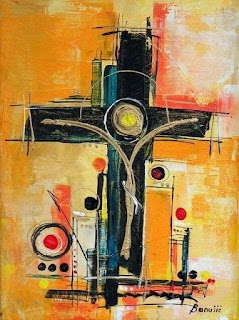
Good Friday of Holy Week 2017

Image
Entry into the City John August Swanson The gathering clouds, the many soldiers, the kinetic energy of the painting, create a sense of foreboding, that something is about to happen to Jesus. Likely not good. The following reflection seems apropos for this Good Friday. A God Torn to Pieces: Good Friday, Nietzsche, and Sacrifice By Adam Ericksen 4 -16-2014 Friedrich Nietzsche is a favorite whipping boy among Christians. It’s difficult to blame my fellow Christians for this. After all, Nietzsche is known for many provocative anti-Christian statements, but his most provocative statement might be that “God is dead.” And yet, in his latest book A God Torn to Pieces: The Nietzsche Case , philosopher Guiseppe Fornari makes a claim that is just as provocative: “In the end [Nietzsche] was much closer to Christ than many who would claim to be Christians.” Wait …Nietzsche was closer to Christ than many Christians? How could that be? Niet...

“The Three Days”/Triduum Lite – A Reconceptualization

          A number of churches in North America have regained a sense of the Church Year since the 1960’s. And that is a good thing.           However, lumping the three days of Easter weekend together under the rubric of “The Three Days” is, in my judgment, less helpful than it might be. And that’s because this rubric covers three days of very different theological and historical valency. Being under one rubric, however, tends to obscure the critical differences between them and inclines us to treat them as simply days on which things important to the Christian faith happened. I suggest this is a woefully inadequate approach. And combined with the near universal neglect of Holy Saturday divests what happened on this weekend of much of its meaning and power.           Good Friday-Holy Saturday-Easter Sunday are “The Three Days” of Easter wee...

Why Did Jesus Die? Baxter Kruger

  Why did Jesus die?   Who killed him?   What was his death really about?   I read the four gospels straight through looking for an answer to this question.   Given that I was brought up in Calvinism and modern Evangelicalism (both of which are quite different from the evangelical vision of the ancient church) I expected to find a series of verses that proclaimed that Jesus suffered from his Father the just punishment for our sins.   What I actually found did not fit in with my expectations.   Again and again Jesus told his disciples what was happening.   Here is what I found: Read more at http://us7.campaign-archive1.com/?u=b729a2702cb155e5ecbacddc2&id=8520259394

Good Friday 2016

Image
“Who are You Standing With Today?” Christians and Pagans, by Dietrich Bonhoeffer in July 1944: People turn to God when they’re in need, plead for help, contentment, and for bread, for rescue from their sickness, guilt, and death. They all do so, both Christian and pagan. People turn to God in God’s own need, and find God poor, degraded, without roof or bread, see God devoured by sin, weakness, and death. Christians stand with God to share God’s pain. God turns to all people in their need, nourishes body and soul with God’s own bread, takes up the cross for Christians and pagans, both, and in forgiving both, is slain.

Christianity, when properly understood, is a religion of losers - Giles Fraser

Image
A church that successfully proclaims the message of the cross – death first, then resurrection – is likely to be empty and not full Helpers nail one of 18 symbolic ‘Christs’ to a cross on Good Friday in San Pedro Cutud, Philippines. ‘The Christian story, like the best sort of terrifying psychoanalysis, strips you down to nothing in order for you to face yourself anew.’ Photograph: David Greedy/Getty W hen he was nothing but a suspended carcass, dripping with his own blood and other people’s spit, there were no worshippers around clapping their hands and singing their hymns. They were long gone. At the very end, ironically at the moment of greatest triumph, he had no followers left. That says something profoundly counterintuitive about what a successful church looks like. For if the core of the Christian message – death first, then resurrection – is so existentially full-on that nobody can possibly endure it, then a church that successfully proclaims that message is likely t...

Quantum Theology: How Good Friday becomes God Friday

Quantum theology begins on Good Friday.   In fact, it turns Good Friday in God Friday.   Here’s how. Quantum physics turned the world of Newtonian physics upside down by showing that it was not the whole story of the physical reality of the world.  It was partially true.  But that partial truth had been inflated into the whole truth such that Newtonian physics was the accepted orthodoxy.  That made quantum physics seem like a threat if not a thoroughly incoherent theory. Quantum theology, which begins with the incarnation of Jesus at Christmas and climaxes at the cross and resurrection, entered a Jewish world full of orthodoxies about how God acts in the world.  Good solid orthodoxies.  Orthodoxies that seemed to have worked for centuries.  Around the edges of the canon are documents that question those orthodoxies (Job, Ecclesiastes) and there are those strange hints of a servant figure in the latter part of Isaiah, but nobody made much of...

Karl Barth on Easter and Good Friday

The mystery of the Incarnation unfolds into the mystery of  Good Friday and of Easter. And once more it is as it has been so often in this whole mystery of faith, that we must always see two things together, we must always understand one by the other. In the history of the Christian faith it has, indeed, always been the case that the knowledge of Christians has gravitated more to the one side or to the other. We may take it that the Western Church, the Church of the Occident, has a decided inclination towards the  theologia crucis —that is, towards bringing out and emphasising the fact that He was surrendered for our transgressions. Whereas the Eastern Church brings more into the foreground the fact that He was raised for our justification, and so inclines towards the  theologia gloriae.  In this matter there is no sense in wanting to  play  off one against the other. You know that from the beginning Luther strongly worked out the Western tendency—not ...

Atheists of the Church Unite! A Good Friday Reflection

Image
Good Friday is our day! It’s a great day because it’s the one day the truth is on full display. Some say “It’s Friday, but Sunday’s coming!” But I say to you, TGIGF – “Thank God it’s Good Friday.” Good Friday (hereafter GF) is the day the truth is on full display because it’s the day in the year we have the best chance to hear the gospel! Christmas and Easter have been so enmeshed with sentimentality, consumerism, and poor theology that I fear their force has been severely blunted in our culture. But GF, well, that’s a different story. Tough to commercialize a vile murder! Or get sentimental about torturous death! (It’s possible, I know. I remember Mel Gibson’s The Passion of the Christ. But not likely.) Bad theology is always a risk. We just have to deal with it. GF is good news not BECAUSE Jesus died on the cross. GF is good news because JESUS died on the cross. Religion, the State, the Economy, the Military all conspired to kill him - in the name of their g...

Good Friday Reflections

Cross Talk ~ crux probat omnia Life through the lens of the cross / Biblical and theological reflections by Michael J. Gorman What makes Good Friday “good”? Or, what is the meaning of Good Friday? The first thing to say is that it is good only in light of Easter. Given the reality of Easter, it is good because it reveals the depth of God’s love and communicates that love to us in order to liberate us from Sin and Death and to give us life in abundance and life eternal. ‘Volumes have been written on this, including some by yours truly. Here are just a few reflections summarizing some of what I have written elsewhere at greater length: 1. The main purpose of Jesus’ death was to create the people of the new covenant, who would be empowered by the Spirit of God to resemble Jesus himself: faithful to God and loving toward their neighbors and enemies. 2. The cross is not only the source but also the shape of our salvation. 3. The cross reveals the love, power, wisdom, and justi...

“The Cross is Always Avant Garde”: Good Friday Poetry from R. S. Thomas

Image
Jesus’ life narrows down to one day, the day the church has come to call “Good Friday.” It is the day of his crucifixion, defeat. Those of his followers who had not already fled, watched in depressing horror as Jesus’ life fled him. This day is “good” only in retrospect. We do not give it its due if we see it only from the vantage point of the resurrection. There are some voices, a few, who help us see this day in its own right as a profound and crucial moment in the life of God as of human beings (complicit as we all are in its tragic happenings). One is the Welsh poet-priest R. S. Thomas (1913-2000). His epigram, “The cross is always avant garde” (The Echoes Return Slow) seems to mean that for him the radical challenge of the cross to all human doing and knowing comes first. It forestalls easy answers and complacent faith. In his poem “Petition” Thomas writes that on seeing the “rueful acts” of theft, oppression, murder, and rape inflicted by human beings on each other, h...